Headlines

‘Our success is founded on our inclusive and supportive school culture’

How The Crypt School guides its students to academic excellence

From its ‘teach to the top’ approach in the classroom, to its network of academic and pastoral support structures outside of it, SoGlos sits down with the head of The Crypt School in Gloucester, Nick Dyer, to find out how the school helps its students to flourish academically, with a view to each student getting the best possible start onto their chosen career pathway.

By Jake Chown  |  Published Friday 15 May 2026
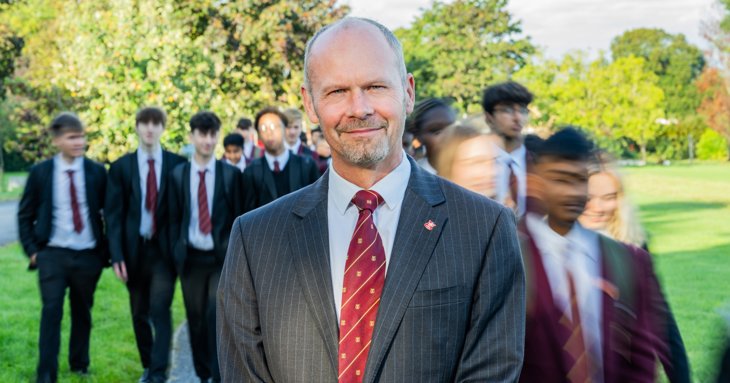
The Crypt School’s headmaster, Nick Dyer, tells SoGlos how the school’s thorough support and guidance helps its students achieve academic success and identify the right career path.

In partnership with The Crypt School | cryptschool.org
The Crypt School

The Crypt School is a co-educational grammar school in Gloucester, which welcomes students aged 11 to 18. It has an excellent academic reputation, an impressive extra-curricular programme and an environment of strong pastoral care to help its students achieve their full potential.

With an approach that puts emphasis on encouraging students to use their newly acquired knowledge to answer challenging questions, The Crypt School in Gloucester has an excellent record of guiding its young people to academic success.

SoGlos talks with the school’s head, Nick Dyer, about how the school helps students to thrive in their studies, from its approach inside the classroom, to extra support outside of it, and how it helps to prepare students for their future careers in an ever-changing landscape.

Tell us about The Crypt School’s academic record.

As a selective grammar school, students come to us with high academic ability to begin with. That’s, of course, a strong advantage in terms of their potential to succeed in their learning journeys; however, as a school we’ve got to work hard to make sure that they do indeed make that exceptional progress that they are capable of across the full range of academic subjects that they study. 

Over recent years, the attainment of our groups in their GCSEs and other exams has further strengthened. For example, outcomes in modern foreign languages have improved significantly, and the school is now one of the best performing schools regionally in those subjects at GCSE.

Science and mathematics have always been great strengths of the school, but we also see students do extremely well in the humanities – history, geography and religious education – and in the creative arts – music, drama and art, for example. Many of our students also excel in and enjoy studying computing, English and more practical subjects such as sports science and food technology. 

We’re fortunate to have very able students at the school, but we work hard to enable them to achieve ‘value added’ in the progress they make over the course of their studies with us.

What approach does the school take to supporting students to succeed academically, in the classroom?

We have very clear expectations of what our student’s learning is going to look like, in terms of the curriculum, but also of what we want them to achieve at key ‘end points’ across the year.

Our approach is to teach to the top, setting high academic expectations for all of our learners to aspire to. However, we provide extra support to those who find the work more challenging at times, which is really important, but we also take away that ‘scaffolding’ over time, enabling students to reach those high grades and make excellent progress in their work. 

We put a lot of focus on questioning – not accepting the first answer given, but asking the students to dig deeper, to think more critically, with skilled teachers bouncing students’ ideas around the room to involve a wider group.

Ultimately, we want to equip our students with the knowledge they need to answer challenging questions, and to ultimately make evidence based judgments of their own. We do have a knowledge rich curriculum here at The Crypt School, but one that seeks to place critical thinking and the development of skills such as oracy at its centre. 

We also want our students to increasingly become independent learners – but students do need to learn how to become more independent in both their work and learning. We have a strong focus on students all developing a growing sense of personal ownership of their progress, and of their work, and that is also a key feature of our sixth form curriculum and approach to learning: that’s about preparing our senior students for university study and the world of work, where they will have to operate independently.

We have a strong and deep rooted culture of celebrating and valuing each student’s progress and achievement here at Crypt which shapes our learning environment; with able and committed learners, and expert subject specialists, supported by a talented team of professional support staff, it’s no surprise our students really excel in their learning.

And of course, those students who have special educational needs are given the support and encouragement they need to excel in their learning and progress, too.

What does that extra support look like for students?

We offer a lot of academic support outside of lessons at lunchtime and after school, particularly in the form of revision sessions for exam students.

We might also identify that a student has challenges with handwriting, there might be students whose literacy skills aren’t as good as we would hope, for example, and they would be identified for extra support. 

Beyond academic support, we also have an outstanding pastoral system here at the school. Students can find the challenge of their school work quite hard, and they need that extra support from a wellbeing perspective.

I think the success that we have as the school is founded on the care that we offer to students, built around our inclusive and kind culture. Whether it’s our counsellors, pastoral support workers, tutors or heads of year, the students know that if they are facing challenges – be they academic or pastoral – there’s someone they can go to for support and guidance. That’s really important and I think it’s something the students really appreciate.

How does The Crypt support students to pursue their desired career pathways post-school, whether that’s university, an apprenticeship, or full-time employment?

The careers landscape is ever changing, isn’t it? It’s challenging for us to know what that landscape is going to look like for the current Year 7, for example, when they go into the workforce in seven to 10 years’ time. 

However, we do have a very thorough careers education guidance programme, that begins in Year 7 and strengthens through to the sixth form. That includes work experience in Year 10 and Year 12; lots of employer engagement activities; an annual careers fair; and we also have an independent careers advisor. All of that is led by our careers leader, who has a full network of contacts drawn from our parental body, our Old Cryptian network and others who want to give up some of their time to support our programme.

We don’t just concentrate on university – 75 per cent of our Year 13s will go to university, but there’s a significant group who are actively seeking apprenticeships and degree apprenticeship opportunities. Over the last few years, we’ve increased our support for those who want to look at apprenticeships, running workshops and replicating employer-led assessment days. There’s plenty of support for writing UCAS applications, CVs, or application letters, too.

Our main aim in the lower years is to give students an idea of the kind of careers that might be available to them, both now and in the future. We utilise labour market information, using a platform where students can record their personal achievements on, but also use it to research what careers are out there, how many jobs are available in the Gloucestershire area, what are the salary expectations and what skills and qualifications they would need to access that kind of career pathway.

What’s really fundamental, too, is the skills and personal qualities that each student is able to develop over their education at the school. If you can communicate well, that will always be something in demand. If you are resilient, there will always be challenges that you will face and can overcome. So, while knowledge and qualifications remain important, alongside that, our young people need those ‘softer’ skills that employers look for.

We know that our careers guidance programme is exceptional – that is what Ofsted said when they inspected the school in March 2024. We have also just had an external audit of our career programme by a company called Careers Mark – we gained their Careers Mark Award three years ago, and we’re aiming to have our programme re-accredited this month. 

Of course, the labour market is in a time of great change: technology and AI in particular are reshaping how people work, and where they work. It is also going to profoundly affect what roles are going to increase in demand, what new roles will emerge and what roles will also disappear: our careers work in school must therefore remain relevant and future focussed.  

And finally, how does The Crypt School balance academic learning with enrichment activities, and why is that important?

Academic learning is central to what we do here, but students want to engage with lots of other things, too. And it’s really important they do that, and through that develop their communication skills, ability to work in teams, to become leaders as well – but our programme is also about each student having fun and building friendships. 

When they leave school and look back upon their school lives in years to come, they often remember those times where they played in a team or went on a trip; took part in a debate, sung in the Cathedral or led one of our clubs or societies; acted in a play or led their House in an assembly – we have a huge programme of extracurricular and enrichment activities here at Crypt – something for everyone to engage with and grow through their participation in.

Our enrichment programme and school culture is also underpinned by our house system which offers lots of opportunities for leadership and for fun, which helps all our students develop a stronger sense of belonging to their school. Our senior students also take on leadership roles as prefects, members of our sixth form student executive team, head boy and head girl. We also have our three school parliaments, which although are focused on important aspects of school life, provide opportunities for students to engage in debate and have their say, so they feel a sense of ownership and belonging to the life and work of the school. 

Our programme builds culture, it enables friendships to flourish, and it helps the students to manage their other challenges – the workload, the expectations that they will do well academically and wider concerns that I think young people have today about our society. It’s a release from all of that and really good for their wellbeing and mental health. So it’s a fundamental part of our curriculum.

Andrew Clements 1950-2026

The Club are saddened to learn of the death of former pupil Andrew Clements.

The following obituary has been extracted from The Guardian.

Andrew Clements, who has died aged 75 after a period of ill health, was for more than three decades the Guardian’s chief classical music critic. His style was a model of critical integrity – authoritative and intelligent, sometimes enthusiastic and sometimes slightly grumpy, dry-humoured yet never showy.

Music may say things that words cannot express, but he mastered the rare art of putting music into words, always using language with precision; reading him, you knew what a performance had sounded like. Best known for championing new music with tireless devotion, Andrew had much wider musical interests than many realised.

However, music was only one of his passions. Topping the list of other fascinations were natural history and Latin American literature, and these strands all came together when he reviewed the world premiere of Peter Eötvös’s opera Love and Other Demons – based on Gabriel García Márquez – at Glyndebourne in summer 2008. Welcoming the work, Andrew ended his review by saying that only the production disappointed “for its failure to evoke any real sense of place, despite the lavish use of video projections full of writhing bodies, insects and reptiles; someone might have pointed out to [the director] that there are no chameleons in South America”.

With such wide interests, Andrew could have taken several professional paths but worked in music journalism – at times as an editor as well as writer – almost all his adult life. But his first job after graduating was in the editorial department of the Open University, where he met Kate (Kathryn) Coltman. They married, and had two daughters, Lara and Holly; they separated in the 1990s.

Andrew served as music critic of the New Statesman for 11 years from 1977, also contributing to Time Out. He had a brief spell (1987-88) as editor of the Musical Times, and wrote for many years (1979-93) for the Financial Times, not only on classical music but also as the paper’s rock and pop critic. Later, in a Guardian classical review he would say that Brian Wilson’s God Only Knows was still the most perfect pop song.

Overlapping with his writing, Andrew was commissioning editor for books on music at Faber & Faber (the publisher’s connection to poets and poetry was not lost on him), midwifing several significant titles. He first wrote for Opera magazine in 1983 and joined its editorial board in 1990. When he succeeded Edward Greenfield on the Guardian in August 1993, the appointment was clinched at least in part by a recommendation from the pianist Alfred Brendel.

An unstinting admirer of some of the most challenging composers – Harrison BirtwistleLuigi NonoElliott CarterLuciano BerioHelmut LachenmannPierre Boulez and Iannis Xenakis among them – Andrew also lent critical support to many less well-known names in contemporary music.

He also had a fondness for the English pastoralist composers of the early- and mid-20th century, and indeed had grown up in Hucclecote, a village that has become a suburb of Gloucester. His mother, Linda, a domestic science teacher before her marriage, was from the Forest of Dean; his father, Joseph, who had grown up on a small family farm in Down Hatherley, to the north of Gloucester, made aeroplane parts for Dowty Aviation.

An only child, Andrew attended The Crypt school, a grammar in Gloucester, and was the first member of his family to go to university. He studied theoretical physics at Emmanuel College, Cambridge, and played the flute in a university orchestra. Contemporaries remember him as a little unsocial and enigmatic – qualities that later allowed him to maintain a professional distance and to write without fear or favour.

With such a background, Andrew was well placed to attend the Cheltenham music festival during its vintage years, and also the Three Choirs festival; this was his first musical landscape, and Elgar’s Dream of Gerontius held special appeal. He would remain more committed than most critics to covering the regional scene.

In 1992 he became a director of the Holst Foundation, honouring the Cheltenham-born composer, and the poetry of Ivor Gurney meant a great deal to him. Reading the Guardian’s Country Diary was a daily ritual (as was doing the paper’s Cryptic Crossword).

Music was not in the family, but his parents had been keen gardeners and lovers of the countryside. Andrew started collecting plants as a boy and was soon ordering Bhutan alpine seeds and indexing specimens. Birds, amphibians and reptiles were special interests, and he kept many creatures as pets – on one occasion, some burglars are said to have been frightened off by his poison dart frogs.

A holiday in Crete in 1979 – his first trip abroad – made a huge impression on him, and Greece would remain one of his favourite countries for the rest of his life. Bird-watching took him the length of South America, from Costa Rica to Ecuador and the Amazon to Patagonia. This he often did with his partner Amanda Holden, the opera librettist and translator, with whom he lived in London for several years. She died in 2021.

Andrew, who I was lucky to count as a colleague and friend for three decades, contributed to The New Grove Dictionary of Music, The New Grove Dictionary of Opera and The New Penguin Opera Guide. He wrote a compact account of the composer Mark-Anthony Turnage (2000). In opera, he responded not just musically but had a strong sense of theatre.

Pianists and the piano literature were close to his heart, and his penultimate review for the Guardian, of previously unpublished recordings by Radu Lupu, had a valedictory feel: “Of the many hundreds of pianists I must have heard in more than 50 years of recital going, a multitude that has included many of the greatest names of the 20th century, none gave me more consistent pleasure or a greater sense of wonder.”

An illness starting in early 2025 meant that Andrew’s last concert review (of the Dunedin Consort) appeared in early March. Despite these difficulties, he retained the sense of humour that countered an often gruff exterior. From his home in Oxfordshire he continued reviewing recordings; his final piece, about Nadia Boulanger’s opera La Ville Morte, was written just before Christmas and published at the start of January, by which time he had contracted the flu that led to his death.

Kate survives him, along with Lara, Holly and two grandchildren.

 Andrew Joseph Clements, music critic, born 15 September 1950; died 11 January 202

The Cryptian Magazine 2025/26

The Cryptian Magazine is now available on line. Please follow this link for the full magazine.

Once again, the school has provided a lot of interesting and informative content – there is so much going on at the school these days both inside and outside of the classrooms.

Steve Knibbs edits the Crypt Alumni content. Please contact *******@**********ns.org“>Steve or Adam with any comments or content for next year.

OCC Reunion Dinner 2025

Excellent All Round

congratulations to the headmaster, all the staff and the pupils for an excellent Ofsted report.
https://www.gloucestershirelive.co.uk/news/gloucester-news/ofsted-raves-gloucester-school-thats-9224259

Richard Abraham (1953-1960)


We are saddened to learn of the passing of Richard Abraham who attended the school from 1953 – 1960.

Richard was an outstanding member of the galaxy of actors directed by Charles Lepper during his golden era of Crypt School productions.

An inspirational teacher throughout his professional career, Richard was also a published author on Russian History.

Our thoughts and condolences go out to Richard’s family and friends.


OC’s Annual Dinner at the Crypt

Please contact *******@**********ns.org“>pr*******@**********ns.org for last minute tickets – the web shop is sold out.

We are delighted to let you know that our Annual Dinner will take place on Saturday 25th March 2023 at the Crypt School. This will be our first full event since 2019, so we are really hoping to see as many Club members, partners, other former pupils and staff members as possible. 

The price of the event will be £33 for members, £36 for non-members and £22.50 for under 21’s.  There will also be a bar for drinks before and during the meal.  The dress code will be smart casual, not least because many of the men probably can’t find their suits (or they need dry cleaning like most of mine!).

Our guest speaker will be Ian Dench (1975-82). Ian is an award-winning songwriter, having written hits for Beyoncé, All Saints, Shakira and Jamie Cullum, among many others.  He’s probably best known for being the guitarist and principal songwriter for local band EMF, who’s debut single Unbelievable became one of the iconic hits of the 90s.  Ian has also held several other roles within the music industry, both at home and overseas. 

Our AGM will also be held on the above date, details of which will follow in the coming month. The timings for the evening will be;

6:15 pm               AGM
6:45 pm               Drinks
7:30 pm               Annual Dinner

So why not use this as an opportunity to get together with friends, lost acquaintances and make new connections (but not in the Love Island sense!).

Any questions, please drop me a line at pr*******@**********ns.org 

Simon

From our President

Dear Old Cryptians,
I was debating with colleagues only three days ago on Friday last week when one can stop wishing people Happy New Year. I think it’s probably mid-January, so I’ve just enough time to wish you a Happy New Year!


There are two really important thing for this eNews – the OCC Annual Dinner and New Committee Members.

First, the Annual Dinner. We are shooting for Saturday 25th March at the school. Resurrecting things after the hiatus caused by the pandemic is not always easy. The momentum is lost and sometimes interest has waned.  But I know from experience, getting back together with people is hugely important and can’t be replaced by technology, as wonderful as that is. For now, all I ask is that you save the date and also complete the shortest of forms ever made –https://forms.office.com/r/dJ5NG2uPsF . This will help us gauge interest in the event before we commit and risk club funds on a non-refundable deposit.

Secondly, the Committee.  Our AGM will also take place at the end of March. We’re always interested in seeking new committee members, but particularly so at this time, when we need to seek the skills that will strengthen our future as a Club. You can find out more on our website here or contact me direct (pr*******@**********ns.org).

Simon Smith
President
Old Cryptians’ Club
pr*******@**********ns.org
 

Calling Future Committee Members

We are looking for new committee members to support the future work of the Old Cryptians’ Club and bring in the skills we need to achieve this.


The Club has a long tradition and heritage, stretching back for more than 100 years. But it also must adapt to ensure and secure its future, reflecting the school as it is now and meeting the needs of younger generations. Most important is enthusiasm and a commitment for change, although we’re particularly interested in former pupils with skills in the following areas;

  • Finance
  • Website/tech skills
  • Communications (online and print)
  • Events
  • Membership/networking

The OCC committee comprises 12 members including officers i.e. President, Vice President, Treasurer and one ex-officio who represents the Centenary Bursary Fund. Committee members are elected for two years and if they so wish can stand for re-election in March at the AGM.


The committee meets 3 times a year, usually in October, January and May (hybrid or virtual) with the AGM in March before the Annual Dinner. Meetings last 90 minutes and are agenda based with reports available before the meeting to allow time for questions/decisions/actions.


Being on a Committee is rewarding and helps you develop skills useful both for work and life. Former pupils of any age or background will always have something to give. If you think you could contribute a small amount of your time please do get in touch with our President Simon Smith (email address president at oldcryptians.org) to discuss further.

Career Journeys

Crypt careers lead Chris Germaine is looking for some OCC input. He writes…

As the new academic year is about to start, I am looking for Old Cryptians who are interested in sharing their career journey since leaving The Crypt? A great opportunity to reminisce about your time at school and staying part of the 1539 Foundation.

I would love to hear from you to create a series of podcasts and video chats to share and inspire with current students, as well as share amongst the OCC network.  I would love it for you to get involved.

Send your details to webmaster@oldcryptians and I’ll forward to Chris.

Website supported by Cass Stephens

Cass Stephens
